
Every operation of the machine is a cycle. Cycles are run one-off or scheduled as jobs, and every measurement is recorded and linked to the plant and the time of measurement.
Weighing and watering
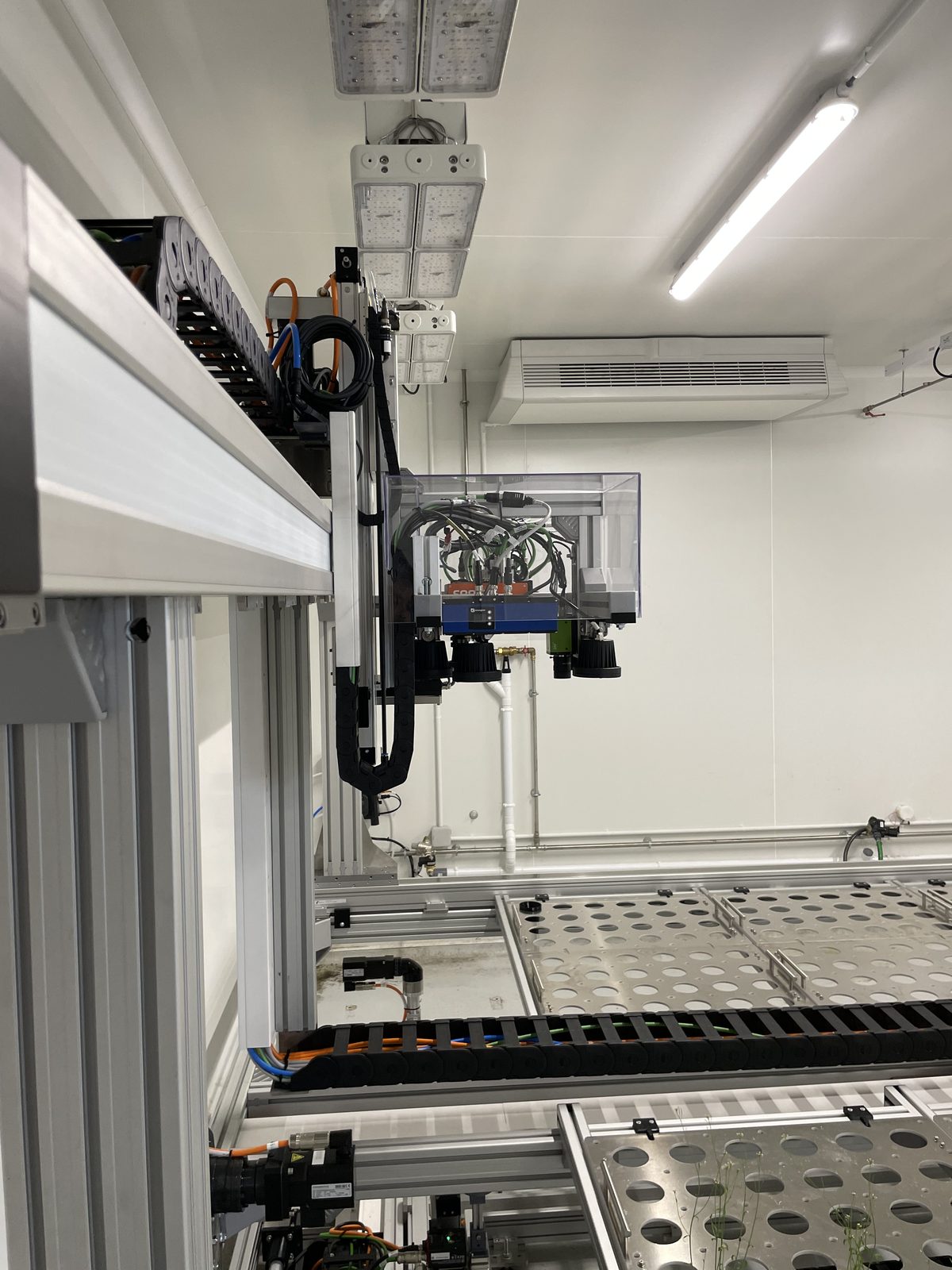
The lower gantry lifts the pot and places it on a balance. From one day to the next, the difference in mass gives the water consumed by the plant.
Watering delivers a precise volume, or whatever is needed to bring the pot back to a target mass — the basis of controlled water-stress studies. Two means: a peristaltic pump with flow control for fine dosing, and solenoid valves for large volumes.
Identification
A Keyence SR-1000 reader reads the Data Matrix code stuck under each pot and on each tray. The machine knows which plant occupies which position and reports moved or missing pots.
Colour and thermal imaging
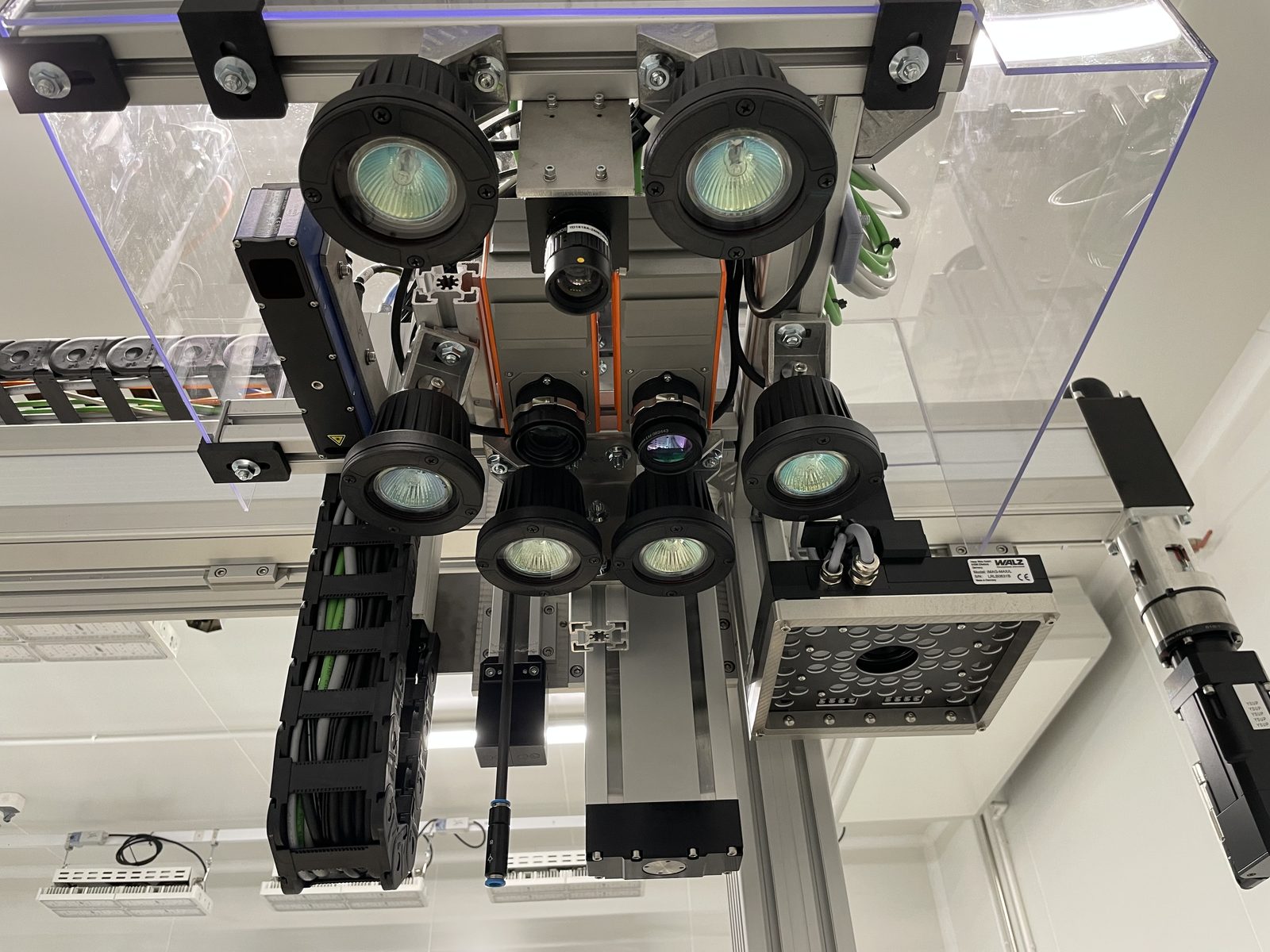
A JAI colour camera and a FLIR A700 thermal camera photograph each plant under halogen lighting. Leaf area and colour indices are calculated automatically; the thermal image shows the plant’s water status.
3D shape and height
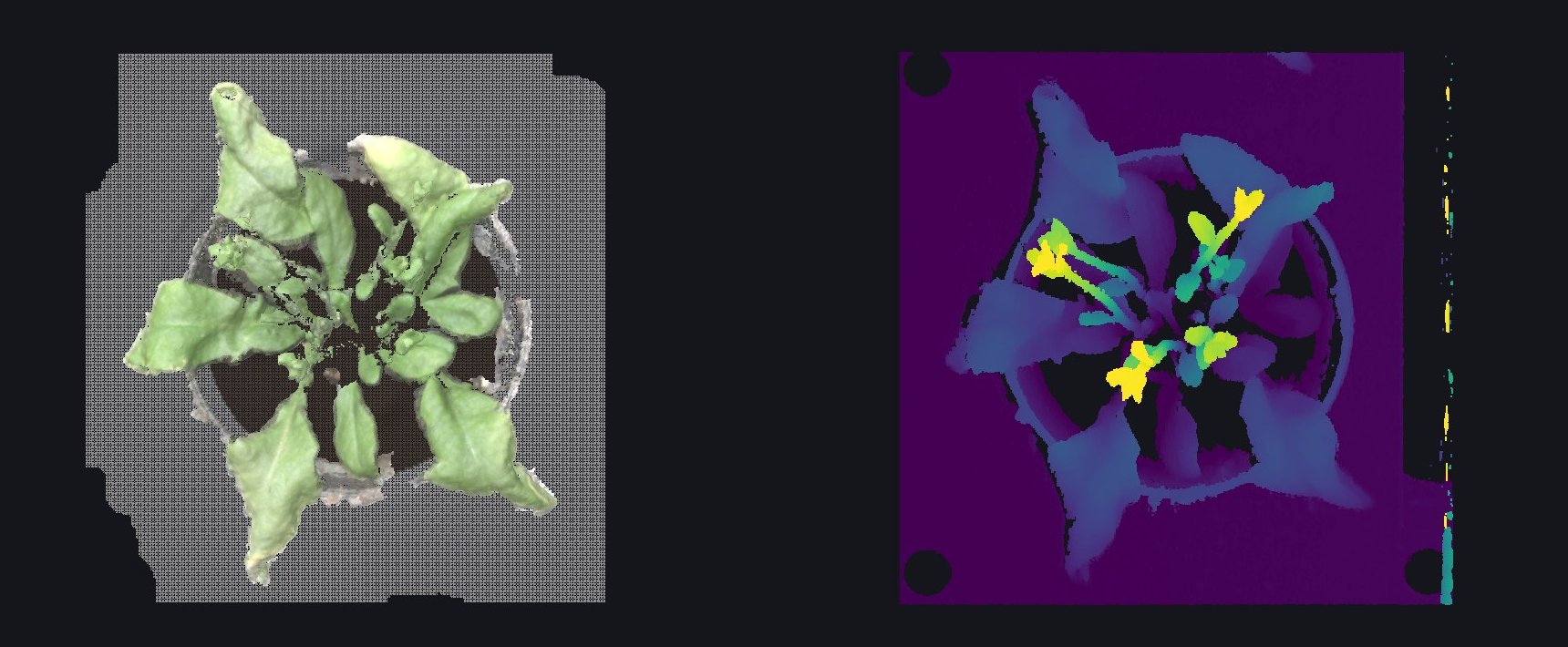
A Wenglor weCat3D laser profilometer scans the trays and reconstructs the 3D shape of the plants. This yields a point cloud and the height of each plant, measured every day.
Hyperspectral imaging
Two Specim cameras, FX10 for visible and near infrared (VNIR) and FX17 for short-wave infrared (SWIR), acquire the spectral signature of each plant for detailed physiological analyses.
Chlorophyll fluorescence
The MAXI head of a Walz IMAGING-PAM moves above each plant and runs the protocol chosen in the job (Fv/Fm…). It is a direct indicator of photosynthetic performance.
Photogrammetry
A grid of photos taken above a tray allows a detailed 3D reconstruction of the plants.
Calibrations
Watering, profilometer, cameras, lighting and the hyperspectral white reference are calibrated from the supervision interface, to keep measurements accurate over time.
← Pheno’R · Measurements and instruments · Web supervision · Data and analysis